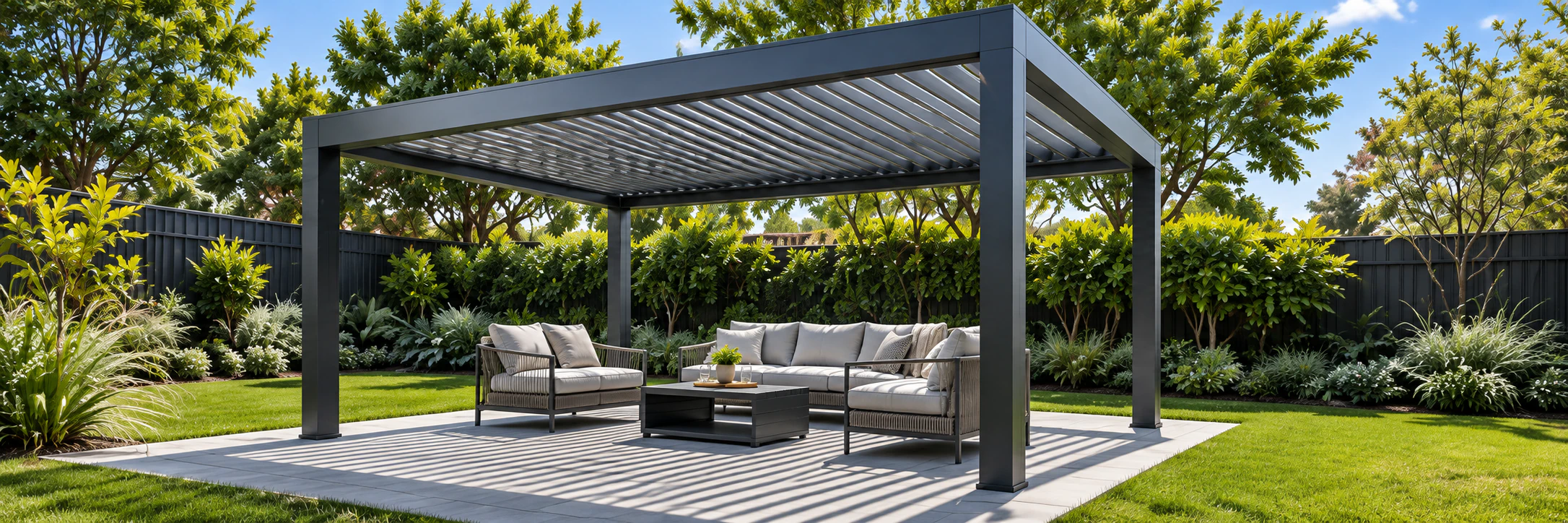
There is no single useful dollar-per-square-metre number for every louvre roof. A modular supply-only kitset, an attached roof and a bespoke architectural louvre project can contain very different scopes. The useful comparison is what the quote includes and which project costs sit outside it.
Planning guidance — final supplied configuration remains project-specific.
01
Start with scope, not a headline square-metre rate
Published New Zealand price guides can be useful for early budgeting, but many quote completed or installed projects. Apollo is supply-focused, so an installed-market figure should not be compared directly with a product-supply quotation without checking structure, freight, installation, foundations, electrical work, drainage, engineering and consent-related work.
Compare quotations line by line: roof system, frame, controls, lighting, enclosure, freight and destination services should be separated clearly enough to understand what is actually being priced.
02
Size changes more than the amount of aluminium
Overall width and projection affect louvre quantity, beams, posts, drainage runs, packaging and freight. Larger spans or reduced-column layouts can also move a project from a modular CADARN pathway into a more architectural ARKEN review.
Shape matters too. A simple rectangular freestanding roof is a different project from a multi-bay layout, roof-only retrofit or structure coordinated around an existing building.
03
Manual, motorised and controlled roofs have different scopes
Manual operation can keep the control package simpler. Motorised operation adds motors, power planning, controls and service access, while selected projects may also include lighting, sensors or smart-control pathways.
Those items should be identified in the first brief rather than added after a base roof price has been compared.
04
Attachment, foundations and drainage can move the project cost
A freestanding structure needs its own post and foundation strategy. An attached roof introduces the existing building, fixing substrate, flashing and structural interfaces. A retrofit introduces the condition and capacity of the existing frame.
Concealed roof drainage still needs a site discharge route. Foundations, building fixings, stormwater connection, local structural review and installation are project-specific unless expressly included in the quoted scope.
05
Blinds, glass and outdoor-room additions should be priced as a system
Guided outdoor blinds, glass, louvre walls, lighting, heaters and outdoor-kitchen interfaces can materially change the complete project. Side enclosure can also change wind behaviour and fixing requirements.
Declare likely enclosure before the louvre roof is frozen so the initial structure is reviewed for the intended end state rather than the open-roof condition only.
06
Freight and local works matter in New Zealand
Crate size, destination, depot or site delivery, unloading access and the final installation location can change logistics. Long members and larger assemblies need realistic receiving and lifting plans.
Local assembly, electrical connection, drainage, foundations, engineering and any building-consent work should be treated as separate project inputs unless a written quotation expressly includes them.
07
What Apollo needs to prepare a manual louvre-roof quote
Apollo prepares louvre-roof pricing after the project pathway and scope have been reviewed. The fastest route to a meaningful quote is a dimensioned brief with the intended mounting relationship, operation and site conditions.
Essential site functions work without analytics. With your permission, Apollo uses analytics to understand which products, guides and project pathways are useful. Analytics stays off until you allow it.