
Apollo NZ Global

Built Intelligence · Outdoor Architecture · Container pools

Modular Swimming Pools for Resorts, Hotels and Property Developments

Modular pools work best when developers repeat a carefully coordinated configuration rather than treating each delivered unit as an isolated product.

Apollo NZ Global EditorialPublished 2026-11-18Project intelligence
Final product selection, technical documentation and local approval requirements are assessed for each project.
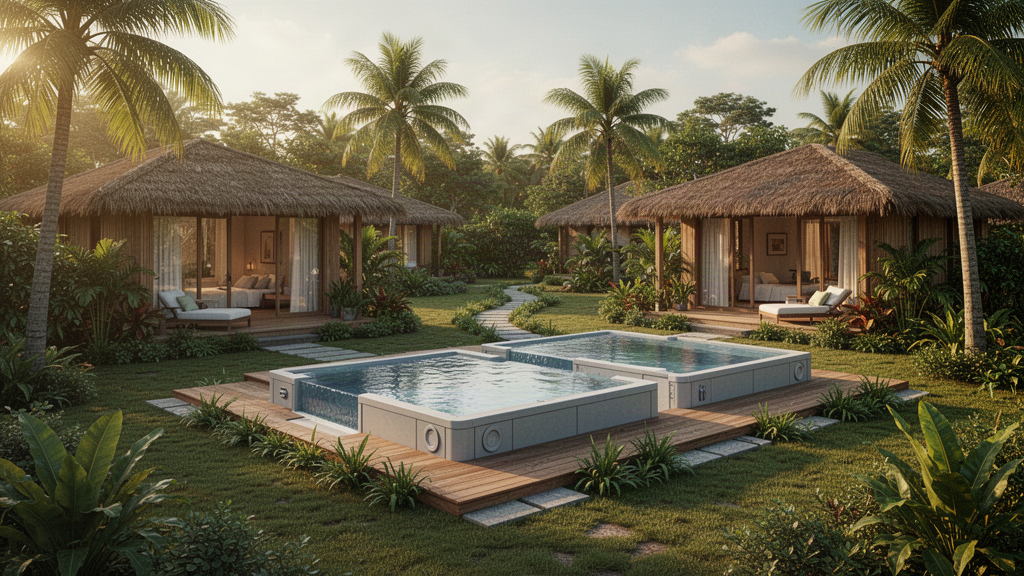
Modular plunge pools integrated into a resort landscape
01

Understanding the project

A modular swimming pool is a prefabricated pool unit or assembly delivered for installation at a prepared site. It may shorten some manufacturing stages, but foundation, lifting, utilities, fencing, local approvals and operational compliance still have to be planned as part of the complete project.

For boutique hospitality, modular pool units can be attractive because they provide a recognisable starting point for shape, construction and project logistics. A developer might propose private plunge pools beside several villas, a compact guest amenity or a phased collection of leisure spaces. Manufacturing repeatability can make that planning more predictable, provided the site is designed to receive the actual units.

The largest mistakes often occur around the product rather than inside it: inaccessible roads, unprepared foundations, concealed service equipment, incomplete safety barriers and construction teams working from provisional drawings. This guide focuses on the project decisions that determine whether modular pool supply becomes practical.
02

Choose a pool type for the hospitality use

Begin with who will use the pool and how. A private guest-villa plunge pool, a shared family pool, a therapeutic leisure pool and a visible main resort feature may require different size, depth, circulation, supervision and service strategies. A shipping-container-format pool is one solution among several prefabricated options, not automatically the best choice for every project.

Describe the guest experience and operation first: expected bather load, privacy, accessibility, operating hours, maintenance access and guest turnover. Only then compare available unit sizes and material families. A pool that is visually appealing but difficult to service can become a poor hotel asset.

03

Repeatable modules can improve masterplanning

For multi-villa developments, repeated pool geometry may help coordinate foundations, equipment alcoves, garden setbacks and logistics. A standardised pool layout can also simplify spare parts and maintenance training. That benefit depends on controlling variations: changing a deck height or hiding equipment at one villa can defeat the repeatable construction concept.

Use a master configuration plus a site-specific schedule. Show where a standard unit is repeated and where slopes, retaining walls, existing trees or unusual access require a controlled exception. The aim is manageable flexibility, not pretending every plot is identical.

04

Delivery and lifting must be designed early

Large prefabricated units require careful assessment of road access, turning areas, overhead services, bridge and road restrictions, unloading positions and crane reach. A short straight-line distance from road to pool location may still be impossible if a unit must pass around existing buildings or over fragile landscaping.

Confirm actual shipment dimensions, mass, lifting points and approved lifting procedures from the selected supplier. The local lifting contractor should determine the crane and rigging plan. Never promise crane capacity or a delivery route using only catalogue photos.

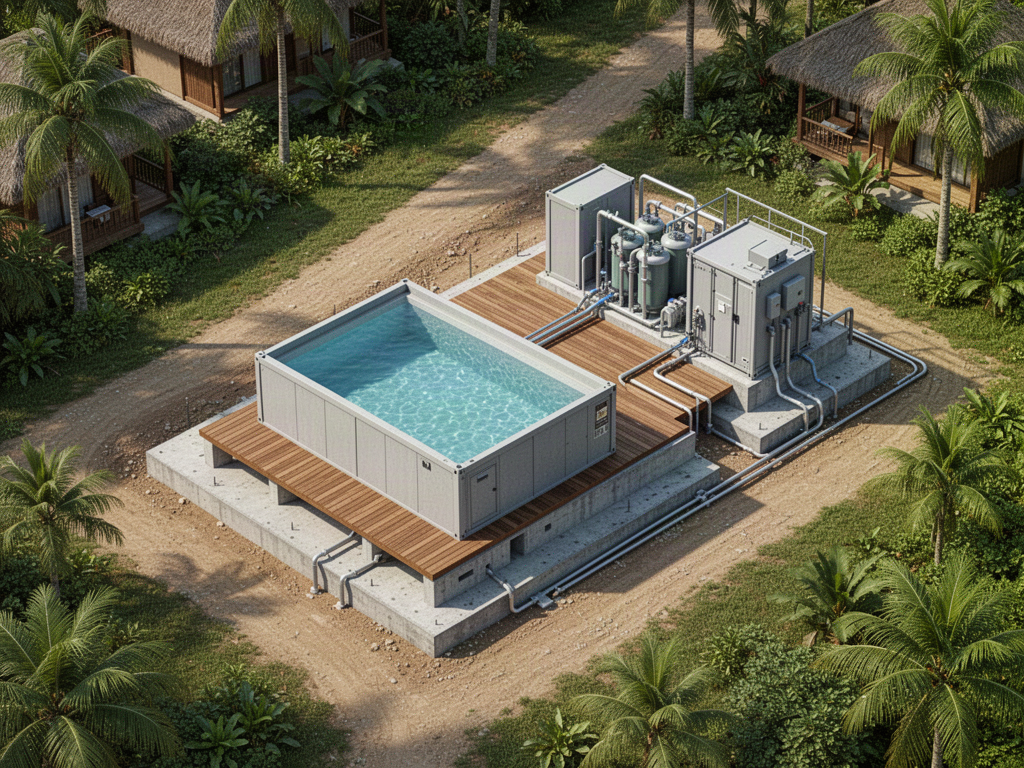
Modular pool showing deck, foundations and filtration access
05

Foundation and ground conditions control reliability

An engineered foundation has to accommodate the filled pool, occupants and any applicable ground, seismic or environmental conditions. Above-ground, partially recessed and deck-integrated formats place different demands on support, drainage and access. Local soils and groundwater may also influence whether a proposed recess is sensible.

Obtain the manufacturer-approved support and interface requirements, then have the local engineer and contractor design the foundation accordingly. The surrounding deck should not hide important inspection points. Water pressure, ground movement and settlement remain civil and structural considerations even when the pool shell arrives prefabricated.

06

Make equipment accessible for the life of the resort

Filtration, sanitisation, pumps, valves, heating and electrical components require space for inspection and replacement. An attractive visualisation may position all equipment beneath tight decking with no accessible service opening. That is a maintenance problem waiting to happen, especially in remote or island locations where replacement parts can take time to arrive.

Set aside ventilated, protected service zones according to the actual equipment requirements. Coordinate safe electrical work, isolation, drainage and equipment noise near guest rooms. Plan a maintenance route that does not require dismantling the entire guest deck.

07

Safety, access and local regulation cannot be outsourced to a catalogue

Pool safety requirements vary by country, use, property type and local authority. They may include barriers, gates, signage, water-quality obligations, accessibility, supervision and operational records. A residential guest-villa pool should not automatically be treated as a public hotel pool or vice versa; the local authority and operator must establish the applicable classification.

For New Zealand residential pools capable of holding 400 mm or more of water, Building Performance guidance identifies physical barrier requirements. Manufacturer and retailer warning notices also have current requirements, including website presentation in applicable cases. Commercial and international destinations need separate local advice, so avoid universal statements.

08

Water quality and climate-specific operation

Hot climates, high occupancy and frequent guest turnover influence water treatment and testing workload. Coastal conditions may affect selected materials and equipment enclosures. Electricity reliability, water supply, wastewater disposal and local chemical availability are especially important for remote resort settings.

Select equipment and servicing arrangements appropriate to the actual operating environment. A manufacturer-supplied plant package does not relieve a hospitality operator of local water hygiene and safety duties. Train the team and retain operating documentation before guest opening.

09

Compare programme cost with total project cost

A prefabricated pool may reduce some on-site fabrication, but the full project includes transport, customs, crane hire, civil works, services, fencing, testing, commissioning, landscaping and maintenance provisions. These scopes can outweigh differences between shell quotations. Request a clear supply-only statement that avoids hiding local costs.

On a multi-unit development, create a standard bill of interfaces for every pool, then price exceptional site conditions separately. This helps a developer compare the real cost per completed guest experience rather than only the imported unit price.

10

Create a modular-pool procurement checklist

Record the destination, pool use, preliminary dimensions, installation format, drawing status, access route, geotechnical assumptions, foundations, services, local authority pathway, equipment location and maintenance provider. Ask for model-specific product drawings, listed inclusions, actual shipment data and warranty terms before committing to civil works.

Apollo NZ Global can coordinate supply-only modular pool product options and technical handover information. Local contractors, engineers, regulators and operators complete the site design, safe installation and ongoing operation. Good integration makes the pool look simple to the guest because the project team has solved the complexity behind it.

  • Confirm intended use and local pool classification
  • Verify access, shipment size and lifting requirements
  • Design foundations and plant access
  • Resolve barriers, water treatment and permits
  • Approve drawings before surrounding works
11

How to plan a repeating villa-pool arrangement

Imagine a boutique development with twelve guest villas, each proposed to have a small plunge pool. The greatest potential benefit of modular units is not a magical installation speed; it is the chance to standardise recurring dimensions, equipment access and supply information. The landscape architect can create a typical arrangement, then identify plots where terrain, privacy, retained trees or access require an exception. The engineer can develop typical foundation assumptions while checking each location's actual ground and loading conditions.

Group the pool drawings, deck interface, service location, barriers, maintenance access and delivery sequence into a master package with a controlled site schedule. A standard unit placed beside a different stair or gate may still create a compliance or accessibility issue. The project manager should record deviations explicitly instead of allowing them to accumulate in subcontractor sketches. This approach helps repeated modules stay genuinely repeatable while giving local teams room to solve legitimate site differences.

12

The difference between factory readiness and guest readiness

A pool can leave a factory with an apparently complete shell yet still need significant local work. Ground preparation, structural support, crane placement, water supply, electrical connections, water-treatment setup, drainage, barriers, landscaping and inspections may be outside the product package. Hotels also require practical operating procedures, staff training and reliable service access before a unit is ready for guests. No supplier should blur the line between prefabricated and ready to operate.

Build a handover schedule that lists each interface, who provides it and the evidence needed before the next phase starts. For example, final pool support geometry should be confirmed before surrounding concrete or decking is poured, and equipment clearances should be checked before cladding conceals a plant area. The developer's progress report should track 'unit delivered', 'unit installed', 'services commissioned' and 'safe to operate' as different milestones. This is more accurate than counting delivery as completion.

13

Design for maintenance in remote destinations

Remote resort operations may have limited access to spare pumps, filters, specialist contractors and rapid replacement freight. That makes early choices about serviceable components, parts storage and staff training particularly important. A pool integrated tightly into a beautiful deck but inaccessible to maintenance workers will generate downtime. The site should have practical routes for removing equipment, inspecting connections and controlling access when work is undertaken.

Develop a maintenance calendar suited to the manufacturer's requirements and local health rules, with clear records for water testing, cleaning and servicing. Confirm the availability of consumables in the destination market and assess power reliability. Coastal air, storms and local water chemistry can also affect equipment selection and upkeep. A robust operational plan is not glamorous, but it underpins the guest experience and the commercial viability of a multi-pool resort.

14

Safety and regulation in more than one destination

International wholesale suppliers may serve properties in New Zealand, the Pacific Islands, Australia and other regions, but a single set of pool marketing statements should not be treated as a universal compliance guide. Requirements may depend on residential versus commercial use, permanent versus temporary installation, water depth, barrier configuration and local accessibility or public-health obligations. The operator and relevant local authority must establish which rules apply.

For New Zealand readers, current Building Performance guidance explains residential pool barriers for pools capable of holding at least 400 mm of water, while commercial resort arrangements may involve different duties. For exports, local designers should review destination requirements, including any permits, safe access and sanitation provisions. A supply quotation should say what documentation Apollo can provide and what engineering, installation and statutory approval the local client must organise.

15

Buying questions that reveal project risk

How large and heavy is the actual shipping package? Can the crane reach the intended location safely? What support arrangement does the manufacturer require? Where does the overflow or backwash discharge? Which equipment needs replacement access? Who provides the safety barrier and what approval applies? These questions are easy to ask before ordering and much harder to solve after hard landscaping has been completed.

Can a modular pool be installed directly on any deck or ground surface? No, support requires design for the actual loading and site. Does a container-format pool always mean a reused shipping container? No; confirm its construction and manufacturing process. Is installation automatically faster? Prefabrication can affect programme, but final duration depends on transport, permissions, site works and commissioning. How should developers compare suppliers? Demand model-specific drawings, shipment data, inclusions, service requirements and transparent scope boundaries.

16

A modular pool project information template

Start a pool procurement schedule with the property location, intended user group, proposed module dimensions, water depth, pool installation level and relationship to nearby buildings or decks. Note whether the pool is public, shared or attached to a private guest unit; the legal classification must be confirmed locally. Include an access sketch showing roads, turning areas, lifting positions and overhead obstructions. Identify whether dimensions are concept-stage estimates or verified construction information.

The services schedule should show preliminary filtration, heating, water treatment, electrical requirements, discharge arrangements and an accessible plant area. Record who will design foundations, confirm ground conditions, perform lifting, carry out local plumbing or electrical work and obtain approvals. Ask the selected supplier to provide actual unit weight, packed dimensions, lifting information and model-specific technical drawings before any foundations or decking are committed.

Before releasing the order, compare the final product schedule with the local construction drawing revision. Check that any guest-safety barriers, gates and accessibility details have been reviewed by the right local professionals. Maintain a commissioning and handover list for water quality, equipment operation, staff training and future maintenance. Modular supply can be efficient, but dependable resort delivery still relies on coordinated site work and operational readiness. The final handover should clearly separate manufacturer instructions from local authority approvals, and name the person responsible for ongoing water testing, emergency arrangements, regular inspections and maintaining access to the equipment.

Move from intelligence to project

Apply the thinking to the actual brief.

Open Container Pools Send a project brief
Project